SPHERE members files a petition challenging the newly proposed "Protection of the State from Terrorism" Bill
SPHERE members challenges the new "Protection of State from Terrorism" Bill
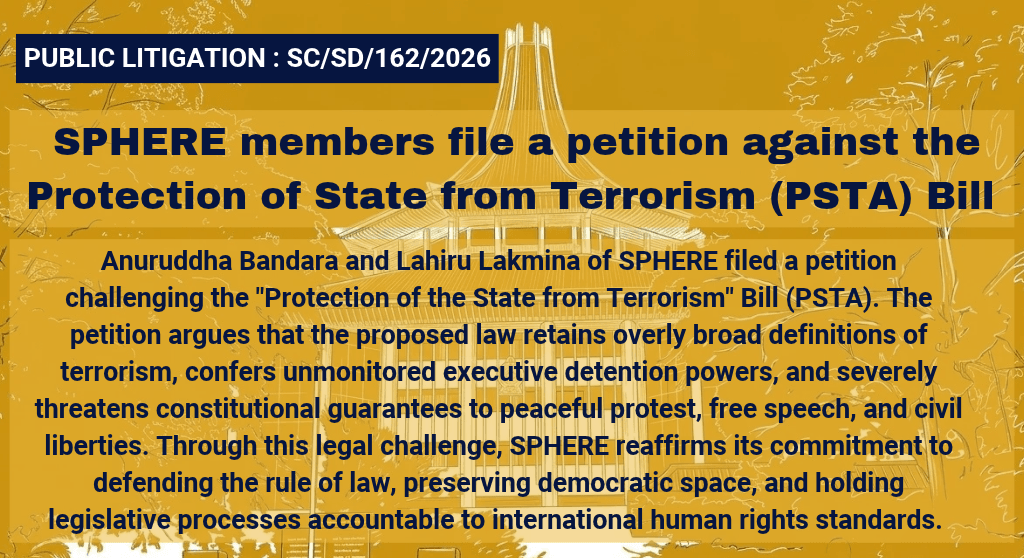
Members of SPHERE has been filed a petition in the Supreme Court of Sri Lanka challenging the newly proposed “Protection of the State from Terrorism” Bill, which was tabled in Parliament on October 6, 2026.
The petition was submitted under Articles 120 and 121 of the Constitution by SPHERE members, Anuruddha Bandara and Lahiru Lakmina .The legal drafting was settled by Attorney-at-Law Tharushi Dishara, represented by Registered Attorney-at-Law Srinath Perera.
The proposed Bill seeks to repeal and replace the Prevention of Terrorism (Temporary Provisions) Act No. 48 of 1979 (PTA), a long-standing piece of legislation criticized domestically and internationally for facilitating arbitrary arrests, prolonged executive detention, and human rights abuses. However, the petitioners argue that the proposed framework merely re-packages many of the draconian aspects of the old law while threatening fundamental democratic rights.
Key Legal Challenges Raised in the Petition
- Overly Broad Definition of Terrorism (Clause 3):
The petitioners contend that the Bill’s definition of terrorism is vague, imprecise, and open to arbitrary interpretation. Phrases such as “unduly compelling,” “likelihood of danger to life,” and “substantial economic loss” lack legal certainty and risk criminalizing legitimate acts of public dissent, peaceful protests, strikes, and civil disobedience.
- Restrictions on Free Expression and Publication (Sections 9 & 10):
The Bill penalizes the publication, dissemination, or possession of “terrorist publications” based on broad concepts of “knowledge” or “direct or indirect inducement.” The petitioners highlight that these provisions pose a serious threat to media freedom, lawful advocacy, human rights reporting, and public commentary.
- Broad Powers of Arrest and Search (Sections 19, 20 & 24):
Extensive intrusive powers to stop, search, question, and arrest are granted not only to police officers but also to members of the armed forces and the Coast Guard. The petition warns that allowing military personnel to exercise law enforcement powers without clear civilian command or immediate judicial oversight risks arbitrary detention and human rights violations.
- Executive Detention & Undermining Judicial Oversight (Sections 27 & 28):
The proposed law empowers the Secretary to the Ministry of Defence to issue initial Detention Orders for up to two months at a time (aggregating up to one year) without prior independent judicial assessment. Moreover, mandatory remand provisions strip Magistrates of their discretion to evaluate individual cases, directly infringing on the right to personal liberty protected under Articles 12 and 13 of the Constitution.
- Criminalizing Silence (Section 15):
The Bill criminalizes the failure to provide information regarding a suspected offense to the police, punishable by up to seven years’ imprisonment or a fine of up to seven million rupees. The petition argues that this undermines the presumption of innocence and effectively penalizes silence.
- Executive Proscription and Restriction Orders (Sections 51, 59 & 60):
The power given to the President to proscribe organizations and to the police to restrict individual movement and assembly on broad grounds creates a severe risk of suppressing legitimate political opposition and civil society organizations.
Relief Sought
The petitioners contend that the impugned clauses violate core constitutional guarantees under Chapter III (Fundamental Rights), as well as Articles 3 and 4, which safeguard the sovereignty of the People.
They are praying for a declaration from the Supreme Court that the proposed Bill cannot be passed into law through ordinary legislative procedures and must instead require a special two-thirds majority in Parliament and approval by the People at a Referendum pursuant to Articles 83 and 84(2) of the Constitution.