MediaMeterLK: The Volunteer Initiative Tracking Media Bias in the 2024 Presidential Election
In the modern digital era, the battlefield of democracy has shifted from physical town squares to the airwaves and digital streams that shape public consciousness. While the proliferation of media channels and online platforms has democratized access to information, it has simultaneously created a complex landscape...

Introduction: Media Bias and Safeguarding Democracy in the Age of Information Warfare
In the modern digital era, the battlefield of democracy has shifted from physical town squares to the airwaves and digital streams that shape public consciousness. While the proliferation of media channels and online platforms has democratized access to information, it has simultaneously created a complex landscape where algorithmic bias, echo chambers, and asymmetric media coverage can quietly distort the democratic process. In an active election cycle, a citizen’s right to a free and fair vote depends entirely on their access to balanced, untainted information.
A defining challenge of contemporary elections is systemic media bias. When influential media stations disproportionately allocate prime airtime to certain favored candidates while sidelining others, they actively tilt the playing field. This disproportionate coverage is not just an unfair broadcasting practice; it is a critical democratic crisis. By controlling the visibility and framing of political contenders, powerful media conglomerates possess the weaponized capability to manufacture public consent, transforming public frequencies—which belong by right to the citizens—into private tools for political engineering.
In this landscape, traditional election observation focusing primarily on physical polling booths is no longer sufficient to guarantee electoral integrity. True democratic resilience now requires data-driven vigilance.
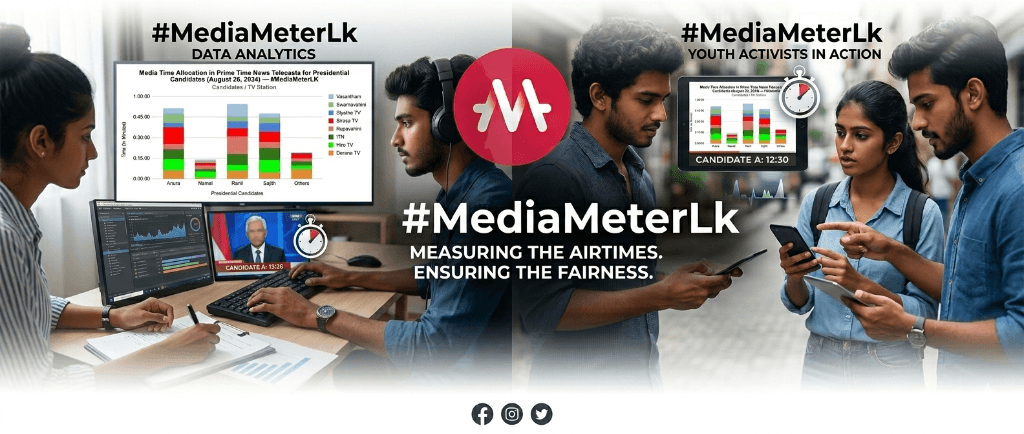
The MediaMeter initiative represents a landmark shift in how civil society fights for electoral fairness in the 21st century. Operating under the hashtag #MediaMeterLk, this youth-led volunteer collective successfully bridged the gap between traditional broadcasting and digital activism. In an era where misinformation and skewed narratives spread at lightning speed, MediaMeter did not just counter bias with rhetoric; they countered it with precise, undeniable metrics. By transforming raw television broadcasts into verifiable, open-source data, they exposed the stark realities of media bias in real-time. Through holding networks accountable and providing voters with easily digestible infographics, the initiative empowered citizens to see past political choreography and make truly informed decisions. Ultimately, MediaMeter stands as a powerful blueprint for the digital age, proving that when technology, rigorous science, and volunteer power intersect, civil society can effectively guard the democratic process against systemic manipulation
About MediaMeterLK
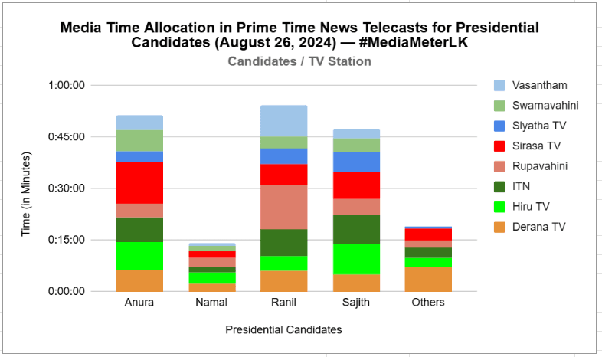 Source - Media Meter public Dashboard - 26.08.2026
During the highly contested 2024 presidential election in Sri Lanka, a landmark volunteer initiative emerged to bring data-backed transparency to public airwaves. Operating under the hashtag #MediaMeterLk, this team of professionals and youth activists took on the responsibility of monitoring how television networks allocated time to various political candidates. Driven by the core belief that public frequencies must be used lawfully and in the public interest, the group worked to expose and prevent media bias.
Media Meter Public Dashboard : Media Meter - Dashboard
Media Meter Methodology : https://bit.ly/MediaMeterLK-Methodology
Media Meter FB Page : https://www.facebook.com/mediameterlk/
Strict Methodology and Scientific Precision
To maintain unassailable accuracy, MediaMeter deployed a meticulous, double-blind calculation process. For every monitored channel, two independent analysts (Analyst 01 and Analyst 02) were assigned to calculate airtime durations.
The exact airtime was down to a precise formula:
Time Allocated = End Time - Start Time
- Start Time: The exact moment the first vowel was pronounced by the presenter, or the very first frame of the video clip, whichever came earliest.
- End Time: The last vowel pronounced by the presenter, or the last frame of the video clip, whichever came latest.
To account for the highly complex nature of political broadcasting, the team openly stated a potential human error margin of approximately +/- 3 seconds per measurement. If discrepancies arose between the two primary analysts, they cross-checked data before passing it to a data entry operator. Furthermore, a dedicated Quality Control (QC) process randomly audited two calculations per week to ensure rigorous standards.
Action on Media Discrepancies: Beyond publishing data, the MediaMeter team actively used their findings to hold networks accountable. When they came across considerable discrepancies or severe imbalances in candidate airtime coverage, the team lodged official complaints with the Election Commission to demand adherence to fair broadcasting standards.
Scope and Categorization
MediaMeter focused exclusively on the prime-time news telecasts of eight major media channels, utilizing their official YouTube channels as primary sources.
The channels monitored were:
- State-owned/Public: ITN, Rupavahini
- Private: Hiru, Derana, Sirasa, Vasantham, Siyatha, Swarnavahini
Airtime was split into two sophisticated categories:
- Direct Allocations: Dedicated coverage including rallies, candidate speeches, party office openings, or official government events where the candidate was featured.
- Indirect Allocations: Airtime given to political parties, trade unions, MPs, or individuals who publicly declared support for a candidate. The team justified this because publicity generated by supporters directly or indirectly promotes a candidate’s candidacy during an active election period.
Note: Certain segments, such as headlines and cabinet press briefs, were strictly excluded from the data pool to avoid skewing the results.
The Team Behind the Initiative
This rigorous monitoring effort was driven entirely by a dedicated core group of volunteers:
- Anuruddha Bandara – Operations Coordinator and Analyst
- Kasun Benthara – Data and Visualization specialist and Analyst
- Jayantha Dehiattage – Analyst and Legal Advisor
- DM Dissanayake – Analyst and Legal Advisor
- Minali Fernando – Analyst
- Nathali Rangajeewa – Analyst
- Lahiru Lakmina – Analyst
- Sachintha Jayarathne – Analyst
- Sathya Charith – Analyst
- Shabeer Mohammed – Analyst
- Chamila Rathnayake – Analyst
- Rukshan Priyanath – Analyst
- Akalanka Senevirathne – Analyst
- Dinesh Wedagedara – Analyst
- Sadew Koswatta – Analyst
- Sathsara Munasinghe – Analyst
Turning Data Into Public Insight
Once verified, the raw numbers were compiled into master spreadsheets to generate weekly and daily reports. These findings were translated into easily digestible visual infographics, featuring individual channel bar graphs, stacked graphs, and pie charts.
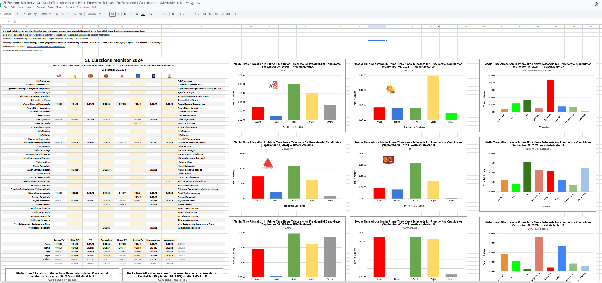 Image - Overall view of the Media Meter - Public Dashboard
To keep the visuals clean, the graphs only featured individual columns for the top four candidates with the highest time allocations, while all other contenders were grouped into a fifth “others” column.
The full albums of these findings were published publicly on the SL Pulse Facebook page within 48 hours of telecasts, empowering Sri Lankan citizens with data-backed transparency right when they needed it most. MediaMeter stands as a powerful modern example of how civil society can leverage technology and volunteer power to guard the democratic process.